The 2026 Law Firm SEO Playbook: Ranking in High-Intent Practice Areas
How top litigation, commercial, and personal injury firms dominate competitive search rankings and capture qualified client retainers using technical topical authority.
1. The Evolution of Legal Search: Why Generic Tactics Fail
Search engine optimization for legal practices has transformed fundamentally. Years ago, a law firm could secure high rankings by publishing brief 500-word location pages stuffed with keyword variations like "personal injury lawyer in [City]". Today, search algorithms evaluate legal content under the strictest "Your Money or Your Life" (YMYL) standards, applying rigorous E-E-A-T (Experience, Expertise, Authoritativeness, and Trustworthiness) criteria.
When an individual or enterprise executive faces an urgent legal crisis, their search queries are highly specific, distressed, and intent-driven. If a law firm website offers superficial content or generic definitions borrowed from Wikipedia, both the searcher and search algorithms recognize the lack of authentic legal depth immediately.
To rank competitively in major metropolitan markets, law firms must establish unambiguous topical authority. That requires comprehensive practice-area silos that examine statutory nuances, procedural milestones, evidentiary requirements, and realistic litigation timelines.
2. Structuring Authoritative Practice-Area Silos
A practice-area silo is an interconnected architectural cluster of content organized around a core legal specialty. Rather than a solitary "Criminal Defense" page, an authoritative silo features dedicated, deeply researched sub-pages for specific offenses, procedural hearings, and defense strategies.
For example, a personal injury practice must branch into dedicated sub-clusters for commercial truck litigation, traumatic brain injuries, rideshare liability, and wrongful death claims. Each supporting guide must link hierarchically back to the primary practice pillar, passing semantic relevance and topical equity throughout the domain.
When internal linking is structured strategically, search crawlers understand the full breadth of your firm's jurisdictional focus. Furthermore, prospective clients landing on any sub-page can easily navigate to relevant case studies or directly request a practice audit to discuss their matter with your attorneys.
3. Dominating the Google Local 3-Pack and Geo-Citations
Over 68% of urgent legal inquiries originate in the Google Local 3-Pack. Whether an injured worker needs representation immediately or a family requires urgent custody counsel, proximity and localized prominence dictate who gets the first call.
Winning in the Local 3-Pack requires far more than claiming a Google Business Profile (GBP). It demands rigorous Category Optimization, geo-tagged citation consistency across trusted legal directories (including Avvo, Justia, Martindale-Hubbell, and FindLaw), and proactive client review acquisition.
Crucially, your GBP landing page must align perfectly with your primary website architecture. When your website possesses superior mobile page speed and structured schema data, Google rewards your firm with expanded map-pack radius coverage across your entire metropolitan territory.
4. Measuring What Matters: Cost Per Signed Retainer (CPSR)
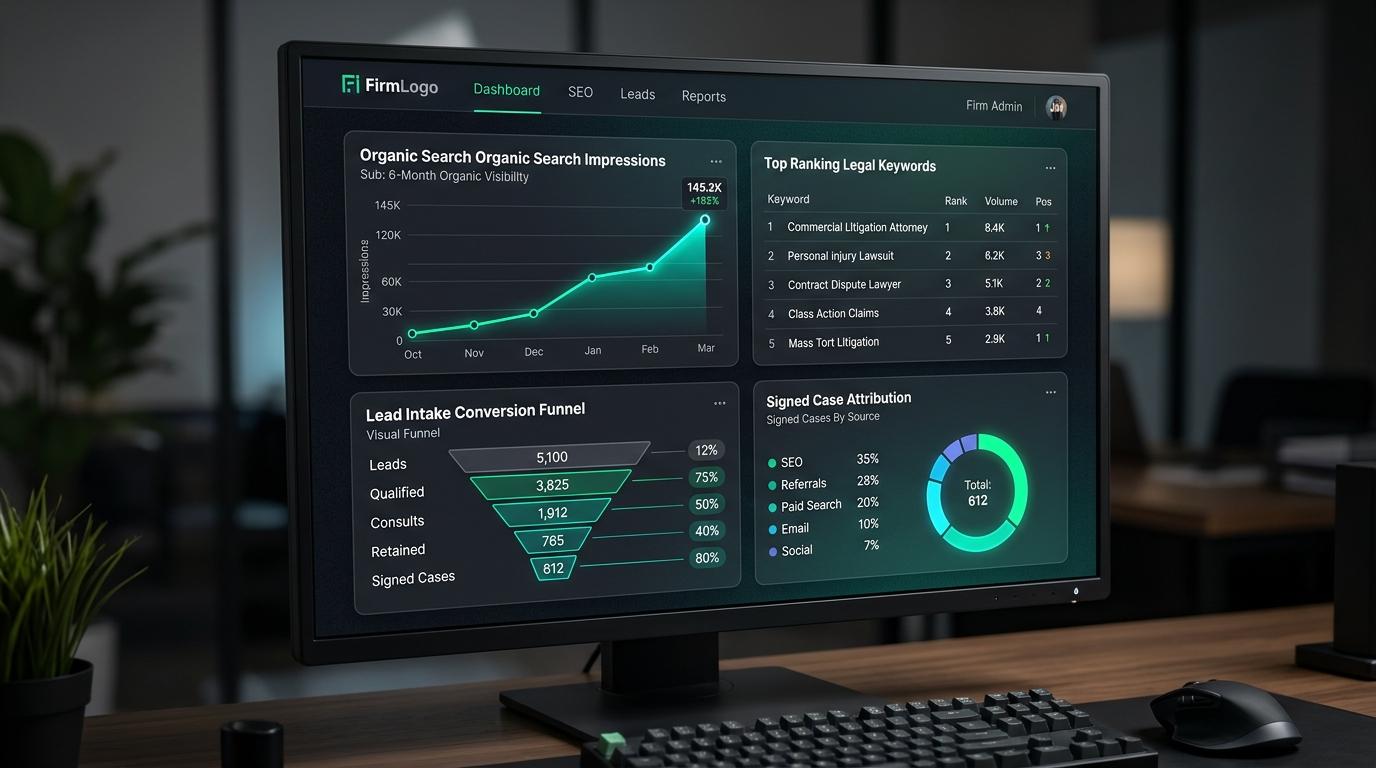
The greatest pitfall in legal marketing is optimizing for vanity metrics: impressions, raw clicks, and unqualified contact form fills. A surge in web traffic that yields unrepresented individuals outside your jurisdiction or cases below your firm's minimum damages threshold wastes intake staff time and produces negative ROI.
Elite legal marketing tracks Cost Per Signed Retainer (CPSR). Every organic ranking, paid ad click, and consultation form must be tagged with dynamic call tracking and CRM attribution. This allows managing partners to analyze precisely which practice silos generate multi-million-dollar case values.
By auditing your firm's intake conversion pathways, eliminating unnecessary questionnaire fields, and deploying transparent retainer models, you turn high-intent organic visitors into retained clients.
5. Actionable Next Steps for Ambitious Law Firms
If your law firm is relying on legacy web templates or suffering from plateaued organic intake, the fastest path to market dominance is a systematic technical and content audit.
Evaluate your current practice-area depth, inspect mobile Core Web Vitals, verify that all published marketing complies with State Bar advertising ethics, and consider securing exclusive territorial representation before direct regional rivals capture your market.
Ready to scale retained caseloads in your target territory?
Compare our transparent Practice Growth Retainers or submit a confidential request for a custom Practice Area SEO Audit.
Scale Your Practice Area Caseload
Get an analysis of your competitive DMA, keyword gaps, and intake funnel.
Related Practice Intelligence Guides
Designing Law Firm Websites for High-Value Intake, Not Vanity Clicks
Why most law firm websites fail to convert distressed visitors, and how friction-free mobile intake architecture transforms consultation rates.
Google LSAs vs. Organic Law Firm SEO: Where Should Attorneys Invest?
An analytical breakdown of cost-per-signed-case between Google Screened Local Services Ads and long-term organic authority assets.